Leonid Kantorovich
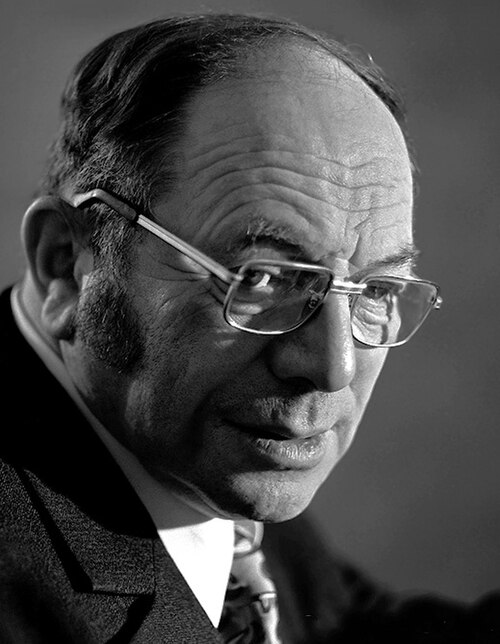
Inventor of linear programming, Nobel laureate 1975
Timeline - Kantorovich in the record
14 referenced events from the Ternary Dreams archive.
Kantorovich is born into a Russian-Jewish family in St. Petersburg. His father Vitali is a well-known physician; almost the whole family, except Leonid, will become doctors.
Kantorovich finishes university at 18 with work of doctoral quality. Because the USSR has abolished academic degrees, he only receives the formal doctorate in 1935 when degrees are reintroduced.
Kantorovich, a professor at the Leningrad Institute of Civil Engineering since 1932 at the age of twenty, now becomes professor at the university.
Kantorovich marries Natalya Ilyina, a doctor like his father and brothers. Their son and daughter will both become mathematical economists.
The Leningrad Plywood Trust asks a seemingly trivial question: how to schedule five veneer-peeling machines to maximize output of eight types of plywood. Kantorovich recognizes a whole new class of mathematics hiding in it.
Kantorovich presents his duality-based solution, calling the dual variables 'resolving multipliers', the mathematical core of what will later be known as linear programming.
During the Leningrad blockade, Kantorovich reportedly computes the optimal spacing of trucks crossing the frozen Lake Ladoga and is said to have walked between the moving vehicles on the ice himself. The episode is legendary and only weakly sourced, but he did receive war decorations for defense work.
Kantorovich writes a book-length account of optimizing an entire economy. His friend Sobolev sends it to Gosplan, to no effect. Shadow prices reflecting scarcity smell of market logic and are ideologically suspect.
Top-secret directive No. 1990-774ss/op orders a computing group of up to 15 staff formed within two weeks at the Steklov Institute's Leningrad branch, with Kantorovich at its head. One account has him calculating differential equations of the bomb explosion in a group assembled by Kurchatov; a Russian state source credits him instead with computing the critical mass of plutonium.
Mathematical heavyweight Andrei Kolmogorov submits Kantorovich's linear optimization work to the Academy's Doklady, giving the ideologically suspect approach crucial cover.
Kantorovich heads the laboratory for applying mathematics to economics in Sobolev's department, gathering young talents like Aganbegyan and Makarov and working closely with Marchuk's computing center.
The Swedish Academy awards Kantorovich and Tjalling Koopmans the economics Nobel 'for their contributions to the theory of optimum allocation of resources', with a shared prize reported by the press at 143,000 dollars. The 63-year-old says in Moscow he is 'very touched': a prize for a method his own country never seriously applied.
Kantorovich is reportedly allowed to travel to Stockholm, a political embarrassment for the Soviet leadership, which is honoring a 'market-adjacent' economist.
He is buried at Novodevichy Cemetery. His student Kutateladze recalled that his efforts to influence economic practice were 'a waste of time and stamina' against the 'governing retrogradists of this country'.
The research file for this dossier holds 9 verified source entries, 9 of them distinct works. The sources page lists every one of them with what it covers, how it was reached, and the sharpest point at which this page and its sources come apart.